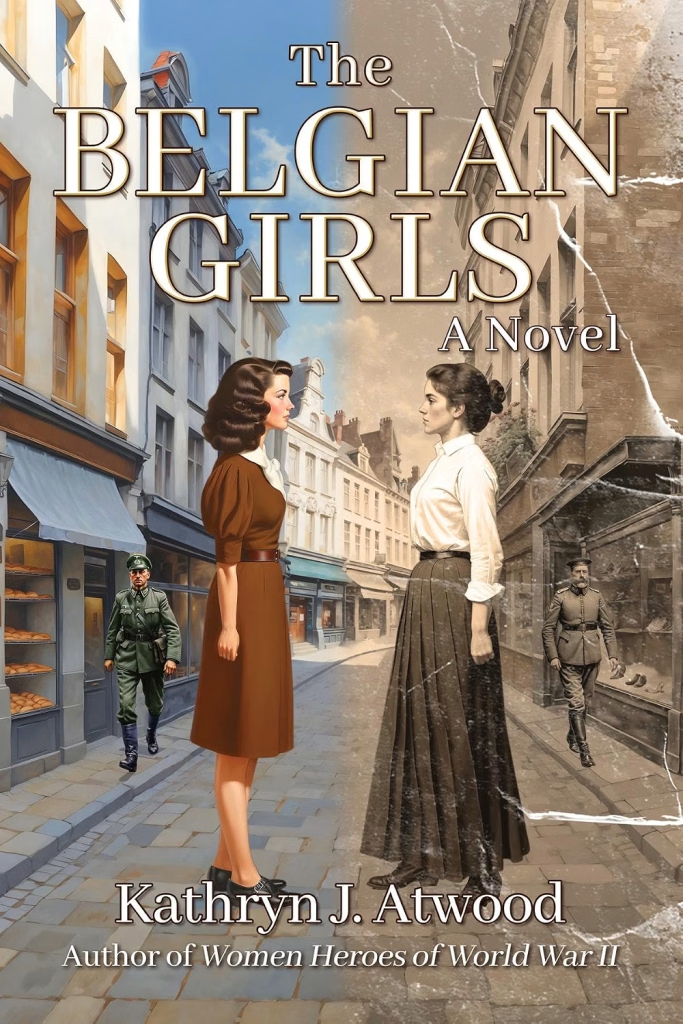
Indie Spotlight and Review: The Belgian Girls

Indie Spotlight is my effort to help Indie authors share their books with others. Marketing an Indie book is a daunting task, and if I can help even a little bit, I will. You can help too by sharing this post far and wide.

Book Review

1942.  After her mother dies, Julienne and her father go to live with her aunt in German-occupied Belgium.  They witness first-hand the terrible treatment of Jews and try to stand up for them when they can.  Julienne is a shy, sensitive girl, so the injustices she sees hit her even harder.  Then she meets Aime while visiting a statue of a famous Belgian spy, Gabrielle Petit, and then landing briefly in a German prison. Although this scares her for a while, after time and other revelations, Julienne decides to go into the Resistance.  She becomes part of Réseau Cométe, or The Comet Line.

1913. After Gabrielle meets Belgian soldier Maurice, she begins to feel love and happiness for the first time, and feels like her outspoken self. In spite of Maurice’s disapproving family, they become engaged. But then the Germans invade Brussels in 1914, and Maurice is off to war. Gabrielle is constantly disparaged and opposed by Maurice’s mother and sister, but she wants to do more to help. She begins nursing fallen soldiers, and then makes a choice to help Belgium even more, by becoming a spy.

I’m not always a fan of the dual-timeline concept, because I often think one is needed much more than the other.  This is not the case here. The two timelines work together beautifully and intertwine in an unexpected way. The link between Gabrielle and Julienne is special, and it makes both time periods relevant to the story. The plot is captivating, and the meticulous research into both periods is evident. Real historical characters, such as Gabrielle Petit, blend well with fictional characters to make a moving and realistic story. The description of Belgium in both periods successfully transports the reader to each point in history. I enjoyed the opportunity to learn about a lesser-known female hero of World War I, Gabrielle Petit. Heart-touching, captivating, and richly described, The Belgian Girls is not to be missed.

About the Author

Kathryn has written multiple young adult collective biographies on women and war for Chicago Review Press. Her first book, Women Heroes of World War II, gets all the attention, but Booklist gave Kathryn’s book on the Pacific Theater of WWII a starred review and likened each chapter to “a cliff-hanger screenplay.” And Courageous Women of the Vietnam War was honored with one of those awards that to unfocused eyes sort of resembles the Newbery Medal.

Her first novel, The Belgian Girls, was born of Kathryn’s admiration for the European resisters of both world wars, especially Gabrielle Petit, a young Belgian woman who worked for British Intelligence during the First World War.

Kathryn has been seen on WGN TV, “America: Fact vs. Fiction,” and the Acorn TV series, “Deception: WWII”; heard on the BBC World Service’s “History Hour” program and BBC America; published in The Historian and War, Literature & the Arts; and featured as a guest speaker at the Harold Washington Library in Chicago, the First Division Museum at Cantigny Park, and the Atlanta History Center.

Apple Books | Amazon | Barnes and Noble

Before You Go

If you read this book, please remember to leave a review on Amazon or wherever you purchase it. Your review does not have to be a masterpiece. Just a couple of lines about how the book made you feel will be so appreciated by authors.

Sunday Post/Sunday Salon: So Many Books!

For the past few weeks, I’ve been trying to sort through review requests and set up a schedule. I couldn’t do it on my own, so I had an AI bot do it. Now I have a schedule, which is booked up to April! I reopened for requests in November, and it lasted a few days before the schedule swelled to the aforementioned April and I had to pause it again. Thanks to everyone sending in requests. I just can’t take them all. I updated the Review Request Policy to indicate that.

Being from Cincinnati, I was shocked and upset to see that the famous and much-loved hippo Fiona died when a child threw a knit hat into her enclosure at the Cincinnati Zoo and she ingested it. They say it was a freak accident when the hat was caught in a ceiling fan and then flipped into the enclosure. But the family didn’t report it. Consequently, the zoo didn’t know what was going on in time, and the hat ended up in her intestines. A senseless tragedy. More education about how to behave around animals is needed.

Fiona, you will be missed.

Upcoming on the Blog

I read few more Indie children’s books, so I will do mini reviews of those soon. I’m not reading anymore children’s books until next Fall. I have several more books I reviewed for the November issue of Historical Novels Review, so those will be coming soon as well. I’m reviewing The Belgian Girls, an Indie book, tomorrow.

Thanks to Deb at Readerbuzz for hosting Sunday Salon and The Caffeinated Book Reviewer for hosting Sunday Post.

How Was Your Week?

Book Blogger Hop: Your Blog’s Message

Book Blogger Hop is hosted by Coffee Addicted Writer. Every week, there is a new bookish question. This week’s question is below.

What Do You Want Readers To Take Away From Your Blog and Your Love for Books?

I guess the most important point right now is in my blog description: Indie Authors welcome here! At Bonnie Reads and Writes, I review books from publishers of all sizes, but have a special heart for Indie authors.

I also hope people see my love for historical fiction and its many subgenres (especially time travel fiction), and I love to share photos of the Smoky Mountains. The title is Bonnie Reads and Writes, and I haven’t shared writing in a while. I need to start doing that again.

What About You: What do you hope readers take away from your blog?

Book Review: Agrippa by Robert Harris

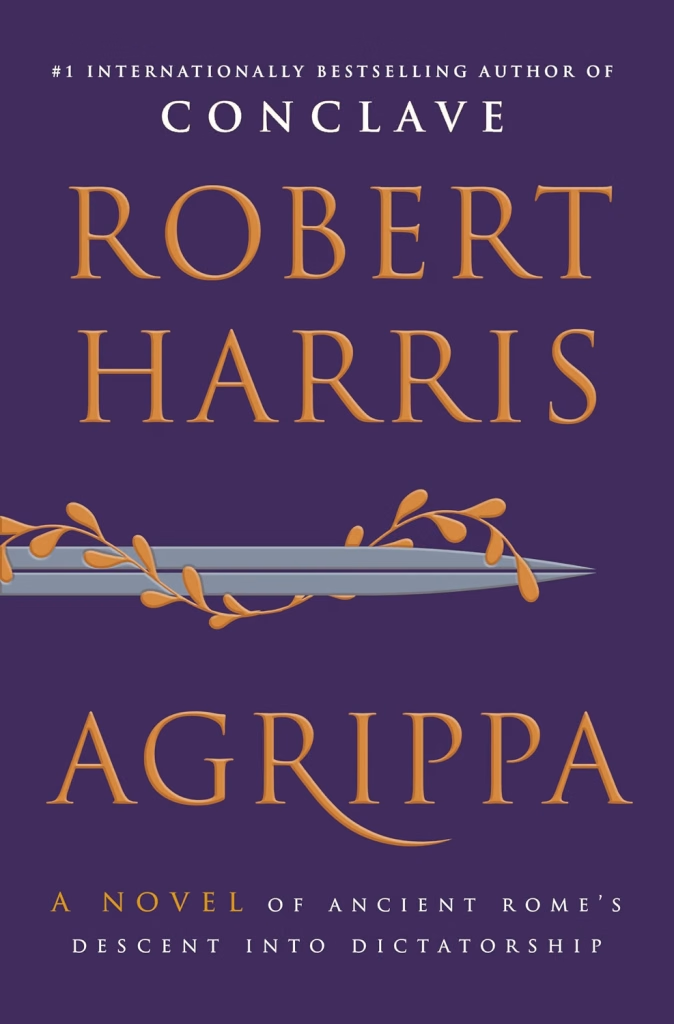
Marcus Agrippa was the general to, and closest confidant, of Caesar Augustus. It has long been assumed that Agrippa wrote an autobiography, which was later lost, and consequently much of his early life is not known. And this is where historical fiction fills in the gaps. This powerful novel opens as Agrippa starts to write this autobiography, which begins with his childhood and first meeting with Julius Caesar’s nephew, Octavius, who would later become the Emperor Augustus. Slowly Agrippa rises from plebeian but childhood protector of Octavius, to a soldier in Julius Caesar’s army, and he is with Octavius when they learn of Caesar’s murder. Octavius is declared the heir in Caesar’s will, but knows he will have to fight for it, and right by his side is Marcus Agrippa. “Once Caesar accepted his inheritance from his uncle, he condemned himself to a perpetual struggle. He had to keep pressing forward, otherwise he would be killed – and I most likely with him.”

Meticulously researched and compelling, this novel paints a vivid picture of Agrippa’s life, and that of Augustus, and outlines the fall of the Roman Republic and its transformation into the Roman Empire. At times, the endless battles seem hard to endure, and the author expertly conveys, through Agrippa, how the people must have felt: “I pitied the long-suffering people of Italy as we passed through their derelict settlements – their property pillaged, livestock stolen, crops unharvested. War, which I had once so relished, was gouged into the countryside like an open wound.”

Rumors about Agrippa’s parentage are brought up and add to the intrigue, but may explain his strategic genius and natural ability to rule in Augustus’ stead. Slight deviations from history, as well as events that occurred after Agrippa’s death, are addressed in the post-mortem. Recommended.

My rating: 4.5 stars, rounded up to 5 on sites with no half-star option.

I reviewed this book for the November 2026 issue of Historical Novels Review, the magazine of The Historical Novel Society.

I received a free copy of this book from the publisher. My review is voluntary and the opinions expressed are my own.

Here is link to my review on The Historical Novel Society website.

About the author

Robert Harris is the New York Times bestselling author of many novels, including Conclave, Dictator, Agrippa, Munich, The Second Sleep, The Fear Index, V2, and An Officer and a Spy, winner of the Walter Scott Prize for Historical Fiction and the American Library in Paris Book Award. Several of his books have been adapted into films, including Munich and Conclave, which won an Academy Award for Best Adapted Screenplay and was nominated for Best Picture. His work has been translated into forty languages and he is a Fellow of the Royal Society of Literature. He lives in West Berkshire with his wife, Gill Hornby.

Social Media: Facebook

Amazon | Barnes & Noble | Apple Books | Google | Kobo

Mini Review: The Abiding Tree

Book Review

The Abiding Tree is an illustrated parable by Michael Weissman. It is a short, affirming read for those who give so much to others and find they need renewal themselves. Pastors, health care workers, Moms, and many others can benefit from this uplifting Christian story.

This is a short read with illustrations on each page. Scriptures also point you to the one who can make you alive again. If you feel a need for renewal, this parable may be just what you are looking for.

I received a free copy of this book. My review is voluntary and the opinions expressed are my own.

Book Review: My Agrippa by William Twersky

Book Description

Old certainties have vanished. Laws are flouted, norms discarded. The Senate, once the Republic’s proudest institution, cowers under the shadow of brute force. This is not Washington. This is Rome, 27 BCE.

As Rome bleeds itself dry with civil wars and ruthless ambition, two figures lesser-known figures fight to hold things together. Octavia, sister to Rome’s rising first emperor, Augustus, and Agrippa, Augustus’s friend and brilliant commander, stand firm against chaos and betrayal.

Bound by loyalty, love, and a vision for a better Rome, they navigate shifting alliances and simmering conspiracies. But as Augustus’ true ambitions come to light, they must face a final question: when power is absolute, how far will loyalty bend before it breaks? This is the story of the fall of the Roman Republic.

Book Review

27 BCE. My Agrippa creates a fictional love story between Octavia, sister of Octavian, who later became Caesar Augustus, and Marcus Agrippa, a brilliant military leader and Augustus’s right-hand man. The relationship mostly plays out in their respective, imagined memoirs and letters.

The book starts out with young Agrippa and Octavian in school and training, followed by the murder of Julius Caesar, the dictator of the Roman Republic. It then outlines Octavian’s rise to first emperor of the Roman Empire, Caesar Augustus. Through Octavia, we hear of Marc Antony’s betrayal, not only of her, but of Rome, and it is written so well.

Some of the most vivid and compelling scenes in the book revolve around the portrayal of Cleopatra, her capture, and the aftermath.  Her description is quite different than one might read in a legend. These scenes stayed with me long after reading the book.

Marcus Agrippa is portrayed as a Stoic and a brilliant military commander. The constant struggle and drama between many of the elites centers around who gets to become Caesar Augustus’s successor, and marriages, divorces, and children all play a part. Agrippa marries and divorces at the whim of Caesar, as does Octavia. Through the musings and actions of Octavia and others, we see marriage among the elites in the Roman Empire as a duty to be endured, and nothing to do with love.

The fictional memoirs and letters of Agrippa and Octavia are used skillfully by the author to portray the end of the Roman Republic and beginning of the Roman Empire.  Through Agrippa we see battle and military strategy, and through both of them we see the life and politics of Rome.  Well researched and compelling.  Highly recommended.

The Author’s Social Media: Facebook

*Click on the cover to view this book on Amazon.

Book Blogger Hop: More Than One Blog?

Book Blogger Hop is hosted by Billy at Ramblings of a Coffee Addicted Writer. Every week there is a new bookish question.

This Week’s Question

Do you run more than one blog? If so, how do you find the time?

Answer

No, I only have one blog. I couldn’t possibly run more. I am trying to also do Instagram again, but it is time-consuming, so it’s hard to keep up both. EDIT: Edited to add I’m trying to revive a Substack I started last year and haven’t used much. I just imported some of my blog posts there, but I have no idea what I’m doing. Anyone with a Substack that wants to do a follow for follow, let me know.

Question for You

How many social platforms do you run, which ones, and is it hard to manage more than one?

Indie Spotlight: Viet Nam Short Stories by Nguyễn Trong Hiền

Book Description

This is an anthology of 12 Vietnamese short stories side by side with their English translations. The stories range from the Tự Lực Văn Đoàn period in the 1930s to more recent stories written by members of the Vietnamese diaspora living abroad after the end of the war in 1975.

Review

The author/translator, Nguyễn Trong Hiền, writes in the Preface that he wanted to “introduce English speakers to stories that would otherwise be inaccessible to them, while allowing Vietnamese readers to access them in their original language.” The result is a beautiful, eye-opening, and often heartbreaking collection, presented in both languages. Each story is presented in Vietnamese first, and then followed with its English translation. I wish I could read Vietnamese so I could enjoy both versions.

The stories in this collection that recount the aftermath of the Vietnam war, when many South Vietnamese were placed in re-education camps, are so heartbreaking and at the same time, very important to read. The one that stands out for me the most, while they all do, is Baby Puppet by Ngô Viêt Trong, about a little boy who basically lived in a prison camp all or most of his short life.

Nguyễn Trong Hiền writes the forward for each story. He also provides an inspiring biographical story, The Quiet Hero, which he wrote about a corporal in the South Vietnamese military, Võ Phùng Duong, who was severely and permanently wounded but still sent to a re-education camp after the war. Later, Duong began an effort to recover the remains of his fellow soldiers who died at the Battle of An Lôc in 1972 and return them to their loved ones.

At the same time, the stories written in the 1930s are not to be missed either. They tell compelling tales and legends of love, suffering, and sacrifice.

Some tales read as memoirs, and The Purple Color of Myrtles was my favorite of those, though again they are all fantastic. In this one, Nguyễn Hűu Loan tells of his love for his wife, their short marriage, and her death which inspired his famous poem of the same title. He also talks of his opposition to the Communist Party and Hô Chí Minh, and how severely he was persecuted after he left the party.

I highly recommend this anthology, which shows Viet Nam in various time periods, all of which seem tumultuous. Many of the stories serve as an eye-opening look at the harsh realities of communism. Powerful and memorable, this translated work is a gift to those of us who haven’t read these stories and can learn from them.

About the Author

Nguyễn Trọng Hiền (or Hien T. Nguyen as he is known in the United States) was born in North Việt Nam, emigrated with his family to South Việt Nam in 1954, and came to the United States in 1975 at the end of the Việt Nam war. He lived in California and West Virginia before settling in New Jersey.

He worked for Wells Fargo Bank in California, Allied Chemical in West Virginia and New Jersey, and for Johnson & Johnson in New Jersey. He retired from J&J at the beginning of 2018 and is now spending most of his time doing his favorite activities: reading, writing, bird and landscape photography, playing with his grandchildren and Jackie, a Golden Retriever.

In 2012, using the pen name of neihtn, he published on Amazon “Village Teacher”, a love story about the final mandarin examinations in Việt Nam at the dawn of the 20th century.

In August 2020, he published “The Siege of An Lộc”, a novel based on the battle of An Lộc in 1972.

In September 2026, he published Viet Nam Short Stories, an anthology of 12 Vietnamese short stories side by side with their English translations

He is currently working on the Vietnamese and French version of the above anthology.

**Click on the cover image to purchase on Amazon. It is also available on Kindle Unlimited, where subscribers can read for free.

Before You Go

If you read this book, please leave a review on Amazon or wherever you buy books. It is so important to the author. The review does not have to be a masterpiece. A couple of lines about how the book made you feel will make the author’s day. You can also help by sharing this post far and wide, so that as many people see it as possible.

Book Review: The French Illusion by John Grisham

Paul and Chelsea Tanner are enjoying their honeymoon in Paris, and then everything goes wrong. They are kidnapped by terrorists who contact their families, demanding large amounts of money, with the stipulation that they cannot contact the FBI or police, or Paul and Chelsea will die. This is just part of the story. These men have done this before, and one of them is bent on revenge, and every one of the male hostages has been in the U.S. military.

This is a compelling thriller, and a return to the Grisham of old. I was engaged in the story quickly and finished it in less than a day. The plot is more complex than a simple kidnapping, and there are layers to the story. Waterboarding and other tortures are vividly described, pointing to meticulous research. The kidnapping methods are clever, original, and well thought out, and the ending is worth the wait. The thoughts of the characters, especially Paul and the mastermind Nabid, are believable and intriguing. Fans of Grisham and thrillers will like this one.

I received a free copy of this book from Doubleday via Netgalley. My review is voluntary and the opinions expressed are my own.

Amazon | Barnes & Noble | Apple Books | Google | Kobo

Book Review: Rags of Time by Michael Ward

Book Description

Spice merchant Thomas Tallant returns from India to find his city in turmoil – desperately overcrowded, ravaged by crime and seething with sedition. A bitter struggle is brewing between King Charles I and Parliament, as England slides into civil war.

A wealthy merchant is savagely killed; then his partner plunges to his death in the Tallant household. Suspicion falls on Tom, who finds himself sucked into London’s mire of deceit. As he struggles to clear his name, he meets the enigmatic Elizabeth Seymour. Her passion for astronomy and mathematics is matched only by her addiction to tobacco and the gaming tables. Can her brilliance untangle the web of lies that threatens to drag Tom under?

A thrilling murder mystery, set in the murky streets of Stuart London, RAGS OF TIME is an intriguing tale of murder and deception amidst the search for enlightenment, that will keep you guessing until the final dramatic scene.

Book Review

Two things are clear after reading Rags of Time.  The author knows the history of 17th Century England very well, and the novel is meticulously researched.  Two murders occur early in the book, but the mysteries sometimes take a back seat to the daily life and troubles of young spice merchant Thomas Tallant, the main character. However, as he is the main murder suspect, it all eventually comes together.

The way the fictional Thomas is woven into the history of a very chaotic time is admirable, and the shrewd investigator, Petty, who never misses a thing, really jumps from the page as a well-rounded and interesting character.  Speaking of interesting characters, there is a budding romance in this novel between Thomas and the pipe-smoking astronomy enthusiast Elizabeth Seymour. However, I found myself impatient to get past the romance and description of Thomas’s everyday activities and back to the mystery.  That being said, the mystery is resolved in a very satisfying way. 

My take on Thomas is that he is young and has made a lot of mistakes, some of which he acknowledges, but he clearly has more to learn, and I hope to see him grow up in subsequent books.

The ending is truly action-packed and exciting, and the villain is evil indeed.  Packed with history, this is a promising start to the series. Rags of Time is the first book in The Thomas Tallant Mysteries.

About the Author

Michael Ward is an English creator of historical fiction. Born in Liverpool, he was a BBC journalist and journalism academic before turning to non-factual writing.

His debut novel ‘The Rags of Time’ features London in 1639. It marks the beginning of forty tumultuous years, a story of civil war, regicide, republic and finally royal restoration. Politics, religion, commerce, science, medicine – none are left untouched by the ferment of change.

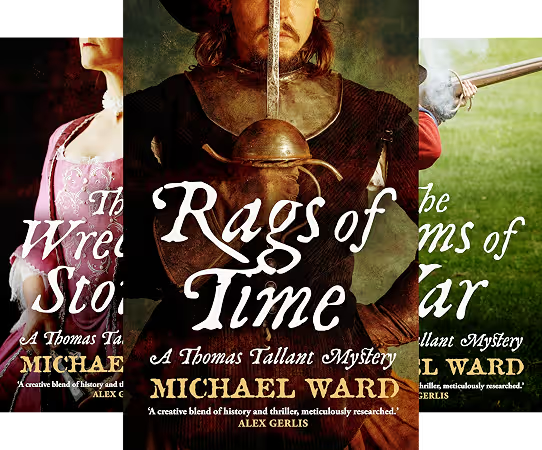
Mike believes it’s the perfect setting for his hero Thomas Tallant’s adventures, starting first with ‘Rags’. The second and third Thomas Tallant books – ‘The Wrecking Storm’ and ‘The Drums of War’ – are also available on Amazon.

*Click on the image below to view each book in The Thomas Tallant Mysteries.